


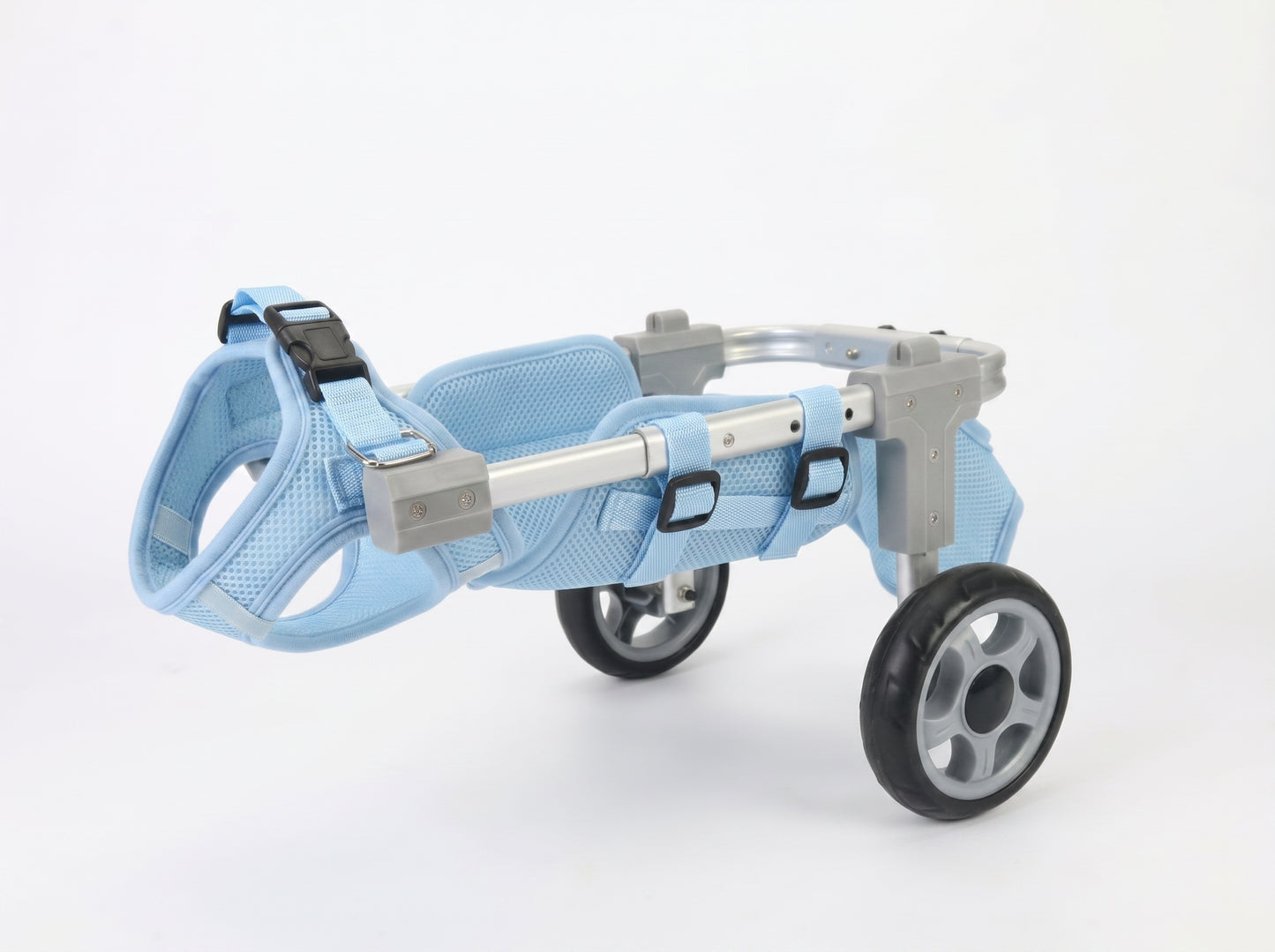

$179.00
Free 90-day returns
If the fit isn't right, send it back. No restocking fee, no argument.
A real person checks your numbers
Send us your dog's measurements before you order and we'll confirm the size ourselves.
Adjusts as they change
Height, length and width all adjust at home — so the frame keeps fitting as your dog's condition changes.
Choosing between them
Two wheels or four?
This is the one choice that matters, and it isn't about budget — it's about which end of your dog needs carrying. Get it wrong and the cart won't help, so read both before you pick.
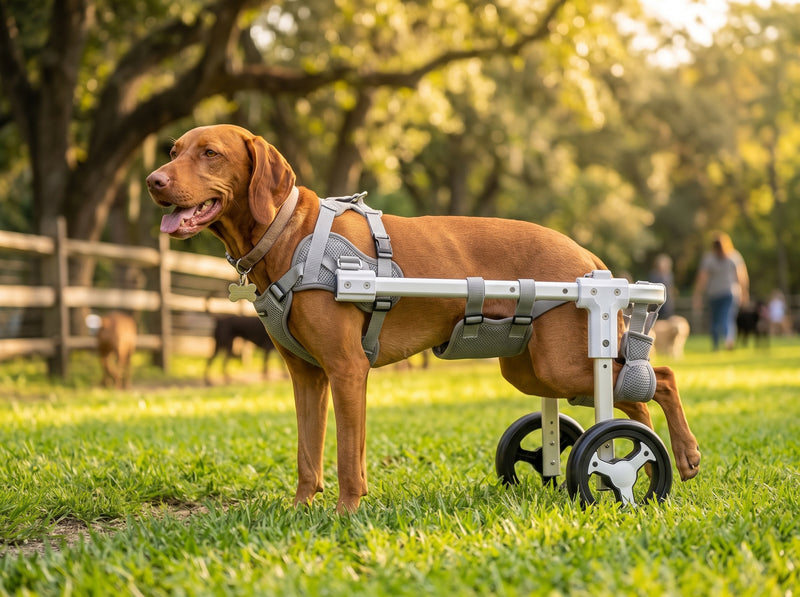
Rear-wheel
For dogs whose front legs are still strong
- Back legs knuckling, dragging or giving way
- Front legs still take weight without slipping
- Can hold themselves upright for a minute or so
- IVDD, disc injury, hip dysplasia, early DM, post-op
Not for: dogs whose front legs have also started to weaken
From $179.00
See the rear-wheel cart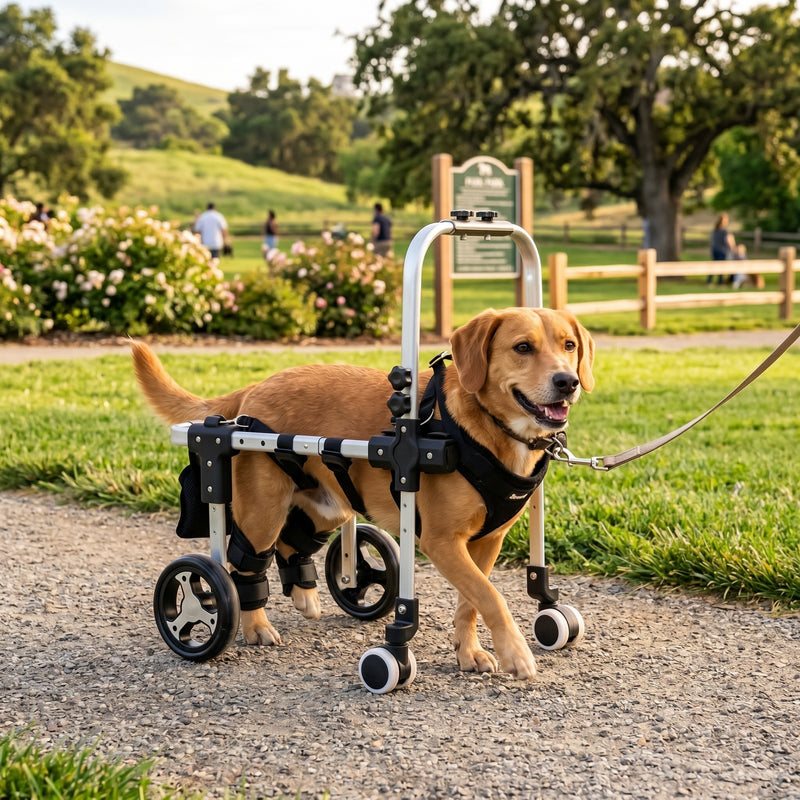
Four-wheel, full support
For dogs who need carrying at both ends
- Front legs slipping, buckling or tiring within minutes
- Can't stay upright unaided long enough to use a rear cart
- Advanced degenerative myelopathy, or weakness in all four
- Also used for dogs recovering from front-limb surgery
Not for: dogs with strong front legs — the rear cart is lighter and easier for them to steer
From $219.00
See the four-wheel cartStill not sure which one?
Tell us what you're seeing — whether the front legs slip, whether your dog can hold themselves up for a minute unaided — and we'll tell you honestly. We'd rather talk you out of the more expensive one than take a return.
The details
What you're actually getting
Specifications
- Frame
- Lightweight stainless steel, multi-section telescopic
- Adjusts
- Height, length and width — all three, at home, no specialist tools
- Wheels
- Solid rubber with anti-slip tread
- Support
- Padded back pad and widened leg wraps
- Rear
- Open by design, so your dog can toilet in the cart
- Surfaces
- Grass, gravel, pavement and packed dirt
- Water resistance
- Water resistant — rain and puddles are fine, submersion isn't
- Assembly
- About fifteen minutes; comes apart again for storage
What happens before it ships
- A person reads your measurements before the order ships
- We write to you if the numbers look unusual for your breed
- Free shipping, 7 to 10 business days
- Free 90-day returns, no restocking fee
Assembly takes around fifteen minutes and needs nothing you don't already own. The frame comes apart again for the car or for storage.
A wheelchair supports mobility. It does not treat, cure or reverse any condition. Talk to your vet about your dog's diagnosis before starting any new mobility aid.
Before you order
Getting the size right
A soft tape measure and someone to hold a treat. That's the whole kit. Take all three numbers in the same session — a dog who shifts position between measurements is the most common reason a size comes out wrong.
If your dog can't hold themselves up, lay them on their side and gently position the back legs as if they were standing normally. Measuring a dog in a collapsed position is what produces a frame that's too short.
-
1
Length: armpit to rump
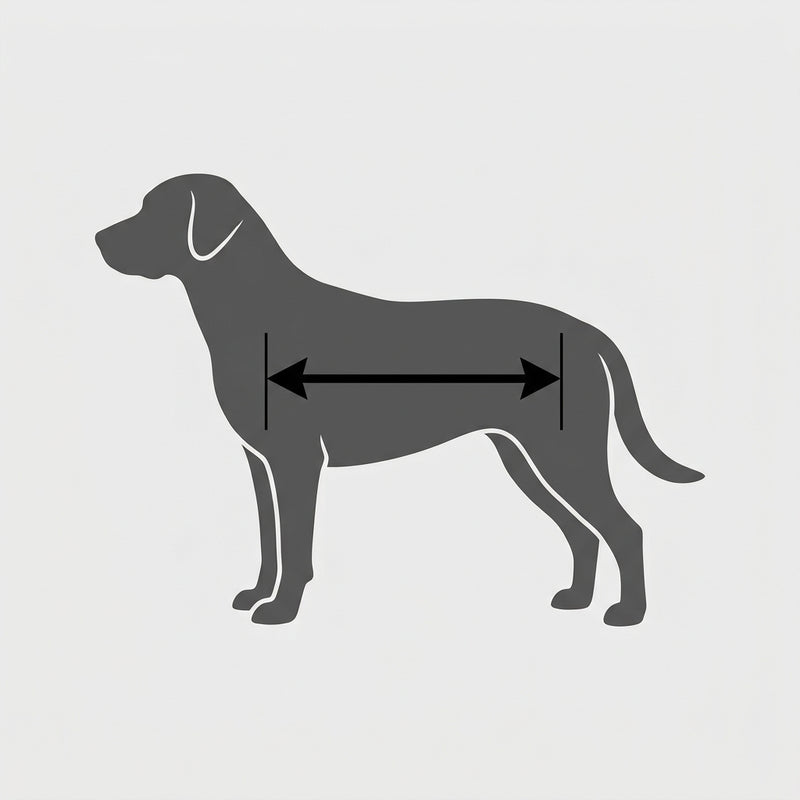
From the crease at the back of the front leg, straight along the body, to the base of the tail. Keep the tape flat against the side rather than following the curve of the belly.
Where people go wrongMeasuring to the tip of the tail instead of where it joins the body. That adds several inches and pushes you a whole size too large.
-
2
Width across the hips
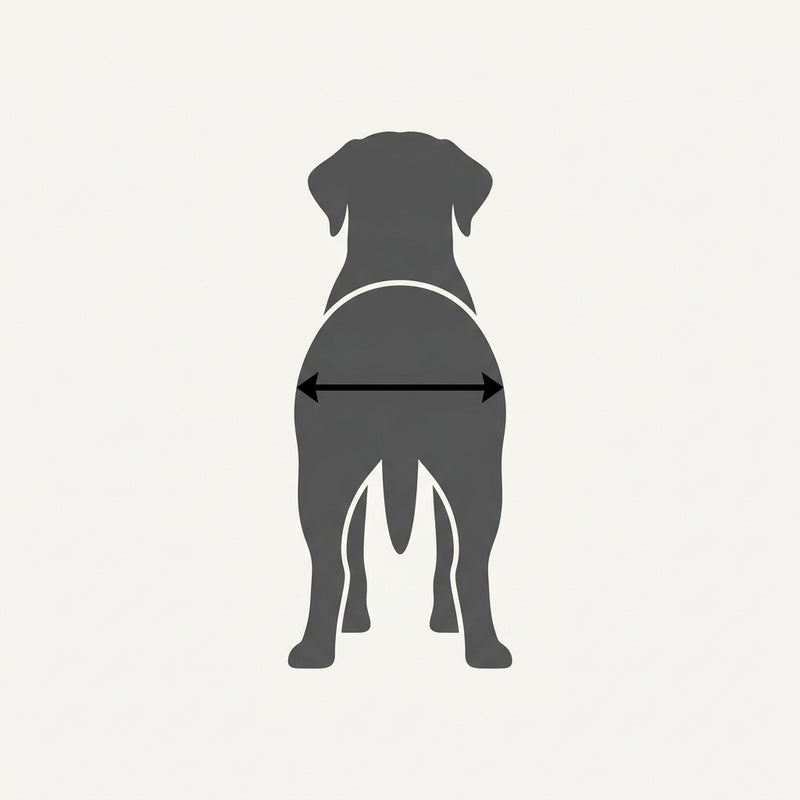
Stand behind your dog and measure the widest point across the hips. Press the tape lightly against the fur rather than pulling it tight.
Where people go wrongMeasuring across the ribs instead of the hips. On deep-chested breeds the ribs are wider, and the frame ends up loose at the back where it matters most.
-
3
Height: floor to the top of the hips
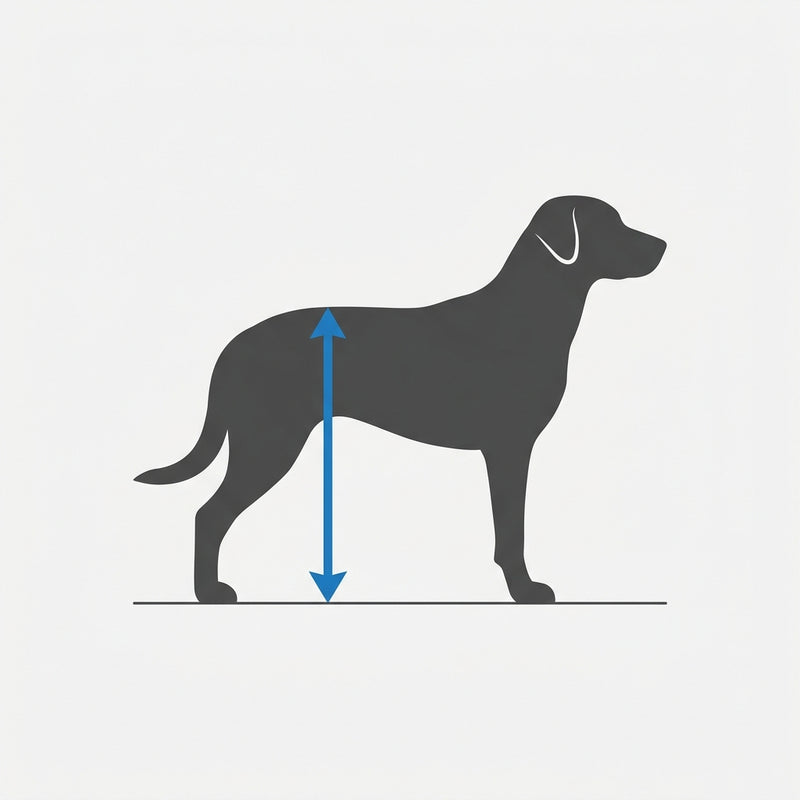
With the back legs positioned as if standing, measure from the ground to the highest point of the hip. This is the number that sets the ride height, so take it twice.
Where people go wrongTaking this one while the dog is sitting or collapsed. If they can't stand, hold the rear in a natural standing position first — a low number here means the cart sits too low to take any weight.
Send us your three numbers before you order. A person here checks them against the size you picked, and if something looks off for your breed we'll come back to you rather than ship it anyway.
Before you order
The questions everyone asks us
Straight answers, including the ones that don't flatter us. If yours isn't here, message us — we'd rather talk it through than have you guess.
Will it hurt my dog?
No — a cart that fits correctly takes weight off the hips and spine rather than adding to it. The support sits under the body, spread across padded panels and leg rings, not pressing on the injury itself. Fit is what decides this, which is why a person here checks your measurements before anything ships.
Can my dog go to the bathroom while they're in it?
Yes, and it's designed that way. The rear stays open and the leg rings support from underneath, so nothing blocks them. Most dogs work this out on the first walk, especially if you take them to the spot they normally use.
How long can my dog stay in the cart?
Start with ten to fifteen minutes at a time, a few times a day, and build from there as their stamina grows. There's no single right answer — it depends on your dog's age, fitness and what their condition allows, so it's worth asking your vet. What matters more than the number: don't leave them in it unattended.
Can they sleep in it?
No. A wheelchair holds a dog in a standing position, which is fine for walks and active time but not for rest. Take them out to sleep, and out for long periods of lying down.
How long before my dog gets used to it?
Most need two or three short sessions. Some walk off in it the first time, seemingly relieved. A few need a week of five-minute goes with treats and a lot of encouragement. If yours is still fighting it after that, message us — nine times out of ten it's an adjustment rather than the dog.
What if my dog just refuses?
Almost always one of three things: the frame is set too high or too low, the harness is tighter than it needs to be, or you've started somewhere overwhelming. Try a quiet, familiar room, keep the first sessions under five minutes, and end while they're still doing well. Send us a photo of your dog in the cart and we'll tell you what to change.
Can they use it on grass and gravel?
Grass, gravel, pavement and packed dirt, yes — the wheels are solid rubber with a tread that grips and enough give to take the jolt out of rough ground. Deep sand and thick mud are hard work for any cart, including ones costing three times this.
Can I use it indoors?
Usually, yes. It depends on your doorways and hallways more than the cart — small and medium dogs get around most homes fine, larger frames need a bit more room to turn. Most owners use it for outdoor walks and take it off inside.
Is it too late for my dog?
Usually not. Dogs use carts happily for years, and dogs with almost no rear function often do best of all, because there's no half-working leg to get in the way. The question isn't how bad the diagnosis sounds — it's whether they still want to move. If they do, it isn't too late.
Will it fix my dog's condition?
No, and be wary of anyone who tells you otherwise. A wheelchair doesn't treat, cure or reverse anything. What it does is let a dog keep moving — and a dog who keeps moving tends to hold onto muscle, appetite and interest in the day, which is worth a great deal on its own.
Will using a cart make their legs weaker?
The opposite, in most cases. Dogs with partial function still push with whatever strength they have, and the cart supports them while they do it rather than doing the work for them. That's what helps slow the muscle loss that comes from not moving at all.
My dog still uses their back legs a bit. Is a cart still right?
Often yes. The rear frame carries the weight while the legs keep working underneath, and you can set the height so the paws still make contact with the ground. If your dog is knuckling or dragging even occasionally, that's usually the point at which owners say they wish they'd started.
How do I know it's fitted properly?
Three checks. The side bars should run level with the ground through the middle of your dog, not sloping. The joint where the frame meets the wheels should sit over the hip. And your dog should be able to touch the ground and push forward without their weight hanging off the harness. If any of those look wrong, send us a photo from the side.
How do I get my dog in and out?
Back the cart up to your dog while they're lying or sitting, lift the rear gently into the leg rings, then fasten the harness. It's awkward the first two or three times and then it isn't. Most owners get it down to under a minute within a week.
What size do I need?
Weight is only a starting point — length and the width across the hips matter more. Run the WagFit Finder for a recommendation in about ninety seconds, then send us the three numbers. We check them ourselves before the order ships and come back to you if anything looks unusual for your breed.
What if it doesn't fit when it arrives?
Send it back within 90 days for a full refund — no restocking fee and no argument. Message us first though: nine times out of ten it's an adjustment we can walk you through in five minutes, and you keep the cart your dog needs.
Do I need my vet to approve it first?
You don't need permission to buy one. But your vet knows your dog's diagnosis and we don't, so it's worth a conversation — particularly if there's a recent surgery, an unstable spine, or crate rest in play. We're happy to talk to them directly if that helps.
Can I adjust it as my dog changes?
Yes, and this is the part that matters over months rather than days. Height, length and width all adjust at home. Conditions change, muscle comes and goes, dogs gain and lose weight — a frame that can't move with them stops fitting within a season.
How quickly will it arrive?
We dispatch within 2 business days, and standard delivery is 7 to 10 business days from dispatch. Shipping is free on every order, anywhere in the United States, and tracking lands in your inbox as soon as it leaves us.
If you're in a hurry because your dog is struggling right now, tell us. We'll give you an honest answer about whether we can get it to you in time — and if we can't, we'll say so.
Do you ship outside the US?
Not yet. On long international routes we can't guarantee a package arrives in the condition it left in, and tariffs make the landed cost unpredictable in a way we're not willing to spring on you at the door. So we've kept things to North America for now, and we ship within the United States while we get the rest right.
If you're somewhere else and stuck, write to us anyway — we'd rather point you toward someone who can help than leave you with nothing.
Still unsure whether it's the right call for your dog? Send us their measurements and a short description of how they're moving. A person will read it and answer honestly — including if we think you should wait.
Ask us about your dog